Monday, May 18, 2015

Back to Abidjan!

Here we go again! I'll be in Côte d'Ivoire from May 20, 2015 until July 27, 2015. This time I'll be carrying out a research project on election preparation and voter education programs in the run-up to the October presidential elections. These elections will be the first since the 2011 post-election crisis, when the country fell into months of violent conflict after both incumbent and opposition candidates declared themselves winners, leaving over 3,000 dead.

I'll be based in Abidjan, but hoping to travel with the Civil Society Coalition for Peace and Democratic Development in Côte d’Ivoire (COSOPCI) as they put on voter education campaigns and register voters throughout the country.  We'll be developing and conducting a survey in Abidjan about the elections and on citizens' perceptions of democracy promotion. This research is supported by grants from the West Africa Research Association and the Human Rights Center at UC Berkeley.

I am excited to return in a different capacity (as a researcher and as a PhD student) and to see how much has changed (or not!) in Abidjan. 

Tuesday, June 18, 2013

Au revoir, Abidjan....

 I will soon be leaving Abidjan.... time really flew! 

Here are some things I will definitely miss....

-          Alloco: these fried delicacies will greatly be missed. However, I bet my heart/arteries will be grateful.
-          Coconuts on the street: Manna from heaven, and they will cut it open for you to drink right there. 100 centimes. Life doesn’t get any better.
 -          Coffee ladies: three wonderful Baoulé ladies serve coffee and sandwiches on my floor at work. Every morning, they laugh at my accent and bring me coffee with a little milk. Sometimes I get an avocado sandwich from them for lunch.
-          Ivorian mannerisms while speaking: “Yako,” “mmhmm”, “on est là,” “ce qui est sûr…” and various hand gestures that go with them.
-          Jacqueville: Paradise. Though a bit of a pain to get to, it was my favorite spot in Cote d’Ivoire due to its beauty and quiet.

-          Maquis: poisson braisé, poulet picqué, alloco, attieke, and good music to boot. In particular, Chez Helene, Chez Ambroise, and BBQ Inn.
-          My colleagues and our missions: I enjoyed traveling to schools in other cities, and my colleagues were great partners for the trips.


-     The Chargeurs: the guys who get us the car in the morning for work. Some of them confessed their love, while others just preferred to practice their English.
     -    Shocking taxi drivers with my accent.
-          Pagne: Bright colors on men and women alike, in interesting styles. Oumar, our tailor, could make anything we drew for him, as long as we gave him a lot of time (sometimes sitting with him for hours while he finished stuff)

-          The hair salon ladies: $7 for a mani/pedi. They are right across the street so I definitely used their services. They loved to ask us to bring them back a “friend” from the USA.
-           The Hash: Both the classic and the Abidjan Hash, this was the once a week chance to leave the city and walk around with good company. I laid the Classic Hash twice, which merited me a very inappropriate Hash name. Fun times.


Classic Hash, Abidjan Zoo, 16 June
Abidjan Hash, November 10

-          Wearing sandals every day
-          New surprises/challenges every day: walk out the door. You do not know what the day holds… it could consist of making a taxi driver giggle with your sad attempts at Nouchi or arguing with fruit sellers about the price of a mango. It could end with the road being blocked from a land slide during the rainy season or a 2 hour traffic jam caused by incompetent military trying to regulate the patterns. You might learn the merits of polygamy from a colleague during a conference or have to explain to other colleagues how to put page numbers into a document. You could eat bush meat in a sticky okra stew or French fries and Lebanese salad. You just never know, and that’s what’s the best about it.

Won’t be missed

-          Apprentis: the kids that yell at you when you are crossing the street: They want you to go on their Gbaka. But I just want to cross the street.
-          Embouteillage: Sitting in hour-long traffic in the heat with pollution coming in the windows…. No thank you.
-          Internet and power outages: With the rainy season came lots of power outages. And our internet was always up and down.
http://www.guardian.co.uk/world/2013/apr/22/delestron-cartoon-superhero-blackout-ivory-coast
-          Negotiating: Every price is negotiable. Though this has positive benefits for the pocket, it can get exhausting, especially if the vendor is giving you a hard time because of where you come from.

-          NesCafe: I can’t wait to have some real coffee. The good kind.
-          Nobody having change: See this post.
-          Open sewers and men using them to relieve themselves: Nuff said.
-          Work drama: bureaucracy and politics, lack of funds, and the like… I sometimes found myself in the middle of “palabres” between colleagues. 

Friday, April 19, 2013

Pomp and circumstance


In Ivoirian culture, and what I am seeing in the office culture specifically, is the importance of greeting people. Every morning, I go around the 5th and 6th floors to greet the Director of the DPFC and his various Deputy Directors. I then also greet my colleagues working on EDHC. What’s most interesting about the greeting process is that it’s in fact not at all rude to interrupt a meeting (unless it’s a very important one) to greet someone. This took me aback at first, when people would just come into my office during a meeting to just say hello.

Every visit we make to a school involves a formal meet and greet with the director of the school. We sit in their overly air conditioned office, and the director, after offering us some water, asks for the news (les nouvelles). Depending on whether the director is a man or a woman, they will ask for the youngest person of the same sex to give the news. They will then ask one of their colleagues to summarize the news to them. In other words, everyone has a mouthpiece that speaks for them. Once the news is summarized, the director of the school welcomes everyone and we can proceed with the purpose of our visit.

Every meeting and conference has an opening ceremony, where some high-up person will give a little speech thanking everyone (and then they sometimes leave right after, not actually participating in the conference). Then a MC is selected that runs the meeting and who is charged with taking down names during the question-answer section. Then there is a closing ceremony where the high-up person returns or sends a representative to give a closing speech. Titles, as I can gather, are very important. And making sure you thank all the right people in your speech is equally so.


More often than not the time allocated to the people of importance and their long speeches exceeds the purpose of the actual ceremony: case in point, I went to the MENET’s day of Excellence awards ceremony where the five speakers took over two hours to do their speeches, whereas the award giving process (to the best school, best teacher, best administrator, best student, etc) took about an hour.

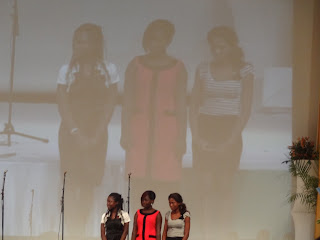
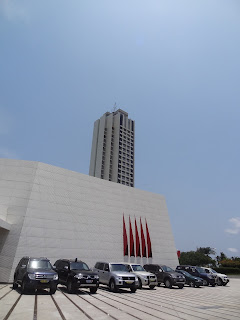
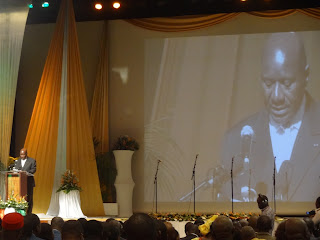
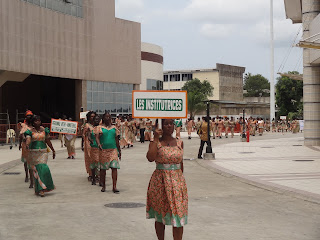
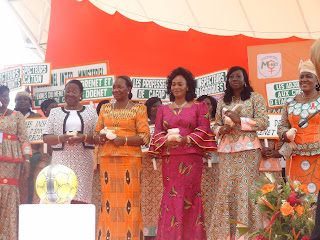
This past month saw two fun ceremonies: the MENET’s Excellence awards and the MENET’s National Women’s Day celebration. Both had comedians, singers, actors that broke up the long speeches. They honored various personnel within the ministry as well as students and teachers. The Excellence awards took place in the fancy Hotel Ivoire and the Women’s day was in the grand Palais de la Culture.  Here are some pictures to enjoy.
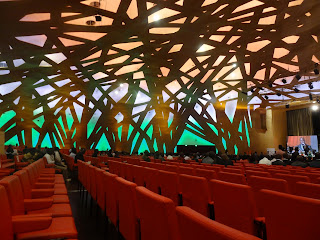
Hotel Ivoire

Madame le ministre giving her welcoming speech

Some of the awardees

Hotel Ivoire

Prime Minister Daniel Kablan Duncan

Women's day

Palais de la culture

Madame le Ministre and the Prime Minister's wife releasing doves

Palais de la culture


Sunday, April 07, 2013

Megalomania in Côte d’Ivoire: La basilique de Yamoussoukro deserves its own blog post


I recently visited the largest Christian edifice in the world, which is interestingly located right here in Côte d’Ivoire.


Taking only three years to be completed (1985-1989), the Basilica of Our Lady of Peace of Yamoussoukro was commissioned by then President, the country’s founding father, Houphouet-Boigny. As mentioned earlier, Yamoussoukro was his birthplace, so it is naturally the perfect site for a building that exceeds the size of Saint Peter’s Basilica in Rome by 95,847 square feet.

When there, one cannot help but wonder the purpose of such a building; though it can hold 18,000 worshipers, it is rare indeed that this is ever the case, as few people actually visit the basilica. Not to mention the more pressing question on priorities: in the late 1980s, early 1990s when it was constructed, Côte d’Ivoire’s economy was in a downward spiral thanks in part to Houphouet-Boigny’s mismanaged cocoa policies. To spend all that money to build such a monument when people are falling further into poverty seems a little misguided, to say the least. But we’re not talking about the sanest character in the world, I suppose (the man put his face next to Jesus’ in one of the stained glass windows….)
http://unevingtaine.files.wordpress.com/2008/09/yamoussoukro-vitral.jpg?w=655
See anyone familiar? http://unevingtaine.files.wordpress.com/2008/09/yamoussoukro-vitral.jpg?w=655
In his book, Wars, Guns, and Votes: Democracy in Dangerous Places, renowned economist Paul Collier makes an interesting argument, somewhat in favor of the basilica:

“…societies throughout history have used monumental buildings to construct a shared identity…the creation of a sense of shared identity is very much what leaders should be doing in these societies.”

But he finishes by saying, “whether a cathedral in the president’s home village was the ideal symbol in a society divided by religion and ethnicity might, however, be questioned.” Especially considering that there is strong belief that the basilica was built in part with funding from foreign aid agencies. Not to mention that if this was in fact the reason Houphouet-Boigny built it – for social cohesion – we can say it was an epic fail: Yamoussoukro remains a city with no purpose and the country experienced its first coup d’état just 9 years after the basilica was completed.

the incomplete hospital
The building was consecrated by Pope Jean Paul II in 1990. He said, however, that a hospital had to be constructed before he would come. Ironically, it took just three years to build the basilica, but the “promised” hospital has yet to be finished (23 odd years later?) In a June 16, 2012 article in the Economist, construction workers at the site said that they expected it to be finished by the end of the year. Obviously this is not the case.

When there, the marble reflects the sunlight to such an extent, you can’t look directly at the large expansive courtyard in the front of the basilica. Inside, 70 foot high stained glass windows depict Christ amidst palm trees. Elevators built inside the giant pillars take you up to the upper levels, where you get an astonishing view down the 23 stories. The dome itself weighs over 98 000 tons. Oh and if you happen to be one of the few worshipers that come to the basilica, you can rest assured that you won’t overheat; each individual seat has a built-in air conditioning.
 
Over the top doesn’t even begin to describe the immensity and the insanity that is the basilica. Enjoy this photo album and try not to ask too many questions about the necessity of such an edifice… just revel in this perfect example of megalomania.