Showing posts with label Man. Show all posts

Wednesday, December 13, 2017

Data collection woes

Man Prefecture
I wanted to know if there was a comprehensive list of organizations that had been registered in Man. Organizations must first register their existence with the Prefecture, and when I went to ask about said list, the administrator said oh yes, thousands of organizations are registered here. Great, any way I can see a list? Oh no, there's no list, we just have all of the files (shows me to the above cabinet).

Prefecture de Bouak茅: Known locally as the "White House" this was the seat of the rebellion during the civil war. The post-2011 government did not want to set-up shop here, so established the Prefecture in a different location. In 2016, this new building was ransacked and destroyed by "young protesters". The prefecture re-established itself in the White House at the end of last year. 

In Bouak茅, we visited the Prefecture: "We used to have a full list. But when the Prefecture was ransacked last year, we lost everything. Hard copies of registration forms, our computers…everything."
Compiling the data I need for my dissertation, thus, will require a little creativity since these two anecdotes are more or less representative of other situations I found throughout the country: a lack of data in electronic format, destroyed documents during the crises, staff turnover resulting in lost or unfinished lists of organizations.

For Ivorian organizations, the loss of the lists is not the end of the world as they receive a receipt when they turn-in their paperwork at the Prefecture, and it is with this receipt that they are able to legally function - a lost file at the Prefecture does not mean they lose their right to work, thankfully. Nevertheless, a lack of a database with NGO registration information makes it difficult for a) the authorities to know who is working in the NGO sector in their department; b) the central state to know how many organizations work in a given sector; c) civil society organizations to know who else works in their domains; d) international donors and partners to know with whom to work; e) PhD researchers to collect comprehensive lists of organizations across the country 馃槙

Alas, this is fieldwork!


Tuesday, November 21, 2017

Man: 18 Mountains, resiliency, and mysticism

In early November 2017, I went the farthest west I have been in C么te d'Ivoire. Man, the capital of the Montagnes district (formerly 18 Montagnes) is nestled amidst the tallest peaks in the country and dense rainforest. Its most western regions border Guinea and Liberia.

Clockwise: The highest peak in C么te d'Ivoire, la dent de Man; the view from the cathedral of Man; sunset; view from Dioulabouga neighborhood, Man
But this region, despite its beauty, was also the site of some of the worst violence the country witnessed during its two crises; it is even known as the "Wild West" because of the lawlessness and proliferation of various armed groups from C么te d'Ivoire and Liberia. Still today it remains a volatile area as the location of current land disputes that resulted in seven deaths and displaced 5000 people in October 2017.

The organizations I spoke with here focused largely on health outcomes: the region has the highest HIV rate in the country, with C么te d'Ivoire having the highest HIV prevalence rate in West Africa and this has had a particular effect on orphaned and vulnerable children; gender-based violence was rampant during and after the conflict; female genital cutting is widely practiced and organizations work to help local leaders understand the negative health impacts of such practices (such as fistulas). After health, social cohesion and poverty reduction were the next most active sectors for NGOs: integrating former combatants proves difficult when victims do not understand why those who hurt them are receiving aid to integrate, while the victims receive nothing. Encouraging groups who fought each other to get along on public good projects proves futile when citizens do not trust their neighbors. Nevertheless, there is a commitment to overcoming the intercommunal violence and develop the region: folks recounted stories of their entrepreneurial endeavors: creating ecotourism sites and developing a rice farming consultancy firm and women banding together to form a co-op to increase local transformation of agricultural products. I admire the resiliency of a population who suffered so greatly in the past and hope that the positive growth seen in recent years will reach these groups.


11/7/2017: Interview with a local health organization

11/8/2017: Interview with an organization that does programming related to orphans and vulnerable children 
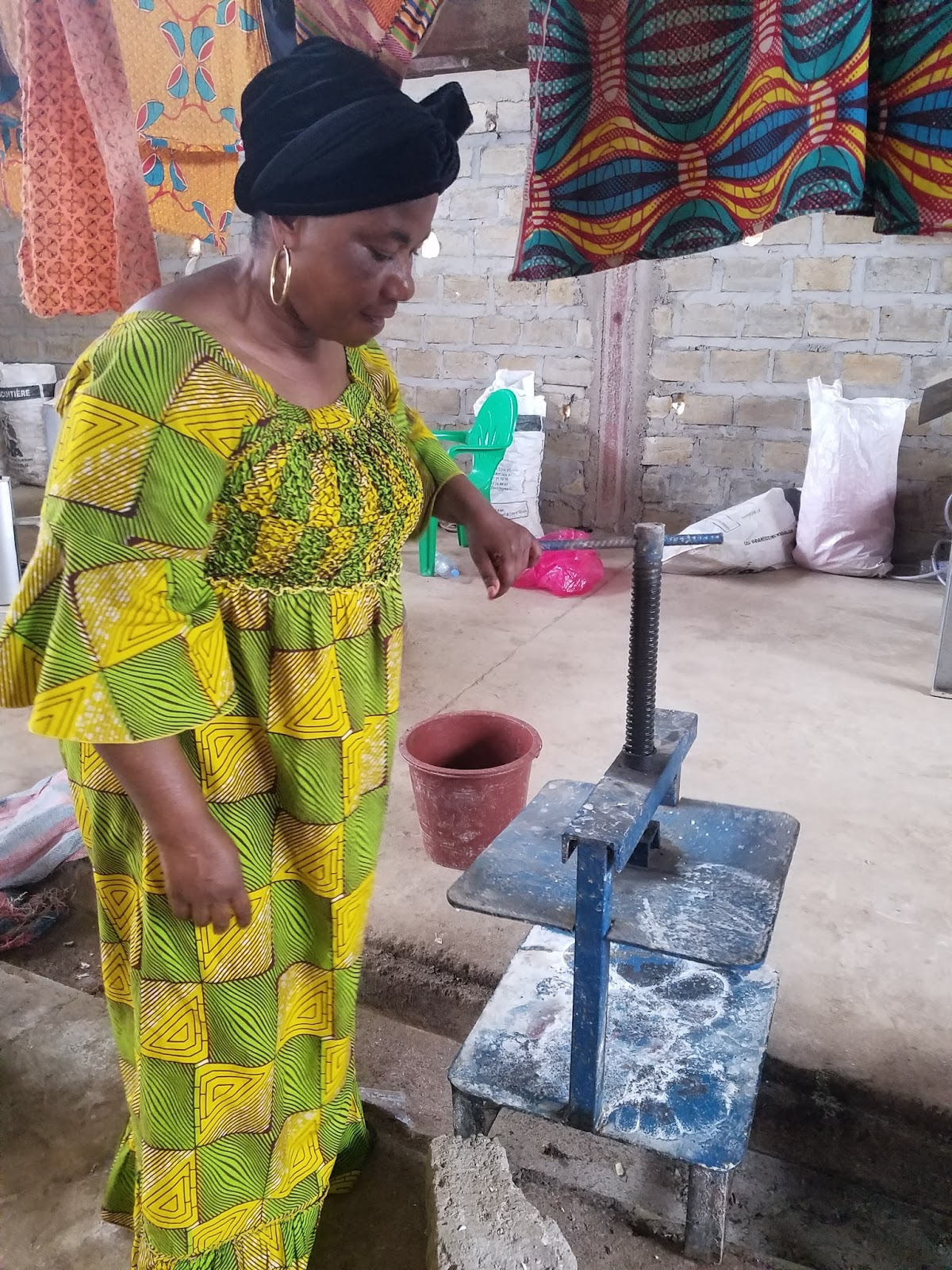
11/8/2017: A women's co-op leader shows me the traditional press for removing liquid from cassava (they just recently purchased a more mechanized processing system)


11/8/2017: Attending an open air session hosted by magistrates and a local NGO on how to access the justice system.
In addition to conducting interviews, I still was able to play tourist: visiting a sacred forest full of tiny monkeys, hiking to the beautiful waterfalls, watching the Elephants lose their World Cup qualifying match, partaking in local alcohol products.

Clockwise: Palm wine in a Wob茅 village east of Man; feeding the monkeys in the Gb锚pleu sacred forest; the famous cascades of Man; rooting on the Elephants in a local bar with NGO folks
I also attended the 7th annual Mask Festival. Traditional masks from across the region and elsewhere made their way to the three-day festival: there were some masks who were aggressive and frightened onlookers, there were humorous masks that encouraged (for a fee) photo-taking, there were masks on stilts, and there was plenty of dancing and mask races. Attendance was high, with young people and old alike laughing and pointing, screaming and running (and then laughing), all trying to get a glimpse of the mystical beings. It was a compelling and intriguing cultural experience.

11/11/2017: Some of the masks we saw at the festival