Showing posts with label Conflict. Show all posts

Wednesday, December 13, 2017

Data collection woes

Man Prefecture
I wanted to know if there was a comprehensive list of organizations that had been registered in Man. Organizations must first register their existence with the Prefecture, and when I went to ask about said list, the administrator said oh yes, thousands of organizations are registered here. Great, any way I can see a list? Oh no, there's no list, we just have all of the files (shows me to the above cabinet).

Prefecture de Bouaké: Known locally as the "White House" this was the seat of the rebellion during the civil war. The post-2011 government did not want to set-up shop here, so established the Prefecture in a different location. In 2016, this new building was ransacked and destroyed by "young protesters". The prefecture re-established itself in the White House at the end of last year. 

In Bouaké, we visited the Prefecture: "We used to have a full list. But when the Prefecture was ransacked last year, we lost everything. Hard copies of registration forms, our computers…everything."
Compiling the data I need for my dissertation, thus, will require a little creativity since these two anecdotes are more or less representative of other situations I found throughout the country: a lack of data in electronic format, destroyed documents during the crises, staff turnover resulting in lost or unfinished lists of organizations.

For Ivorian organizations, the loss of the lists is not the end of the world as they receive a receipt when they turn-in their paperwork at the Prefecture, and it is with this receipt that they are able to legally function - a lost file at the Prefecture does not mean they lose their right to work, thankfully. Nevertheless, a lack of a database with NGO registration information makes it difficult for a) the authorities to know who is working in the NGO sector in their department; b) the central state to know how many organizations work in a given sector; c) civil society organizations to know who else works in their domains; d) international donors and partners to know with whom to work; e) PhD researchers to collect comprehensive lists of organizations across the country 😕

Alas, this is fieldwork!


Tuesday, November 21, 2017

Man: 18 Mountains, resiliency, and mysticism

In early November 2017, I went the farthest west I have been in Côte d'Ivoire. Man, the capital of the Montagnes district (formerly 18 Montagnes) is nestled amidst the tallest peaks in the country and dense rainforest. Its most western regions border Guinea and Liberia.

Clockwise: The highest peak in Côte d'Ivoire, la dent de Man; the view from the cathedral of Man; sunset; view from Dioulabouga neighborhood, Man
But this region, despite its beauty, was also the site of some of the worst violence the country witnessed during its two crises; it is even known as the "Wild West" because of the lawlessness and proliferation of various armed groups from Côte d'Ivoire and Liberia. Still today it remains a volatile area as the location of current land disputes that resulted in seven deaths and displaced 5000 people in October 2017.

The organizations I spoke with here focused largely on health outcomes: the region has the highest HIV rate in the country, with Côte d'Ivoire having the highest HIV prevalence rate in West Africa and this has had a particular effect on orphaned and vulnerable children; gender-based violence was rampant during and after the conflict; female genital cutting is widely practiced and organizations work to help local leaders understand the negative health impacts of such practices (such as fistulas). After health, social cohesion and poverty reduction were the next most active sectors for NGOs: integrating former combatants proves difficult when victims do not understand why those who hurt them are receiving aid to integrate, while the victims receive nothing. Encouraging groups who fought each other to get along on public good projects proves futile when citizens do not trust their neighbors. Nevertheless, there is a commitment to overcoming the intercommunal violence and develop the region: folks recounted stories of their entrepreneurial endeavors: creating ecotourism sites and developing a rice farming consultancy firm and women banding together to form a co-op to increase local transformation of agricultural products. I admire the resiliency of a population who suffered so greatly in the past and hope that the positive growth seen in recent years will reach these groups.


11/7/2017: Interview with a local health organization

11/8/2017: Interview with an organization that does programming related to orphans and vulnerable children 
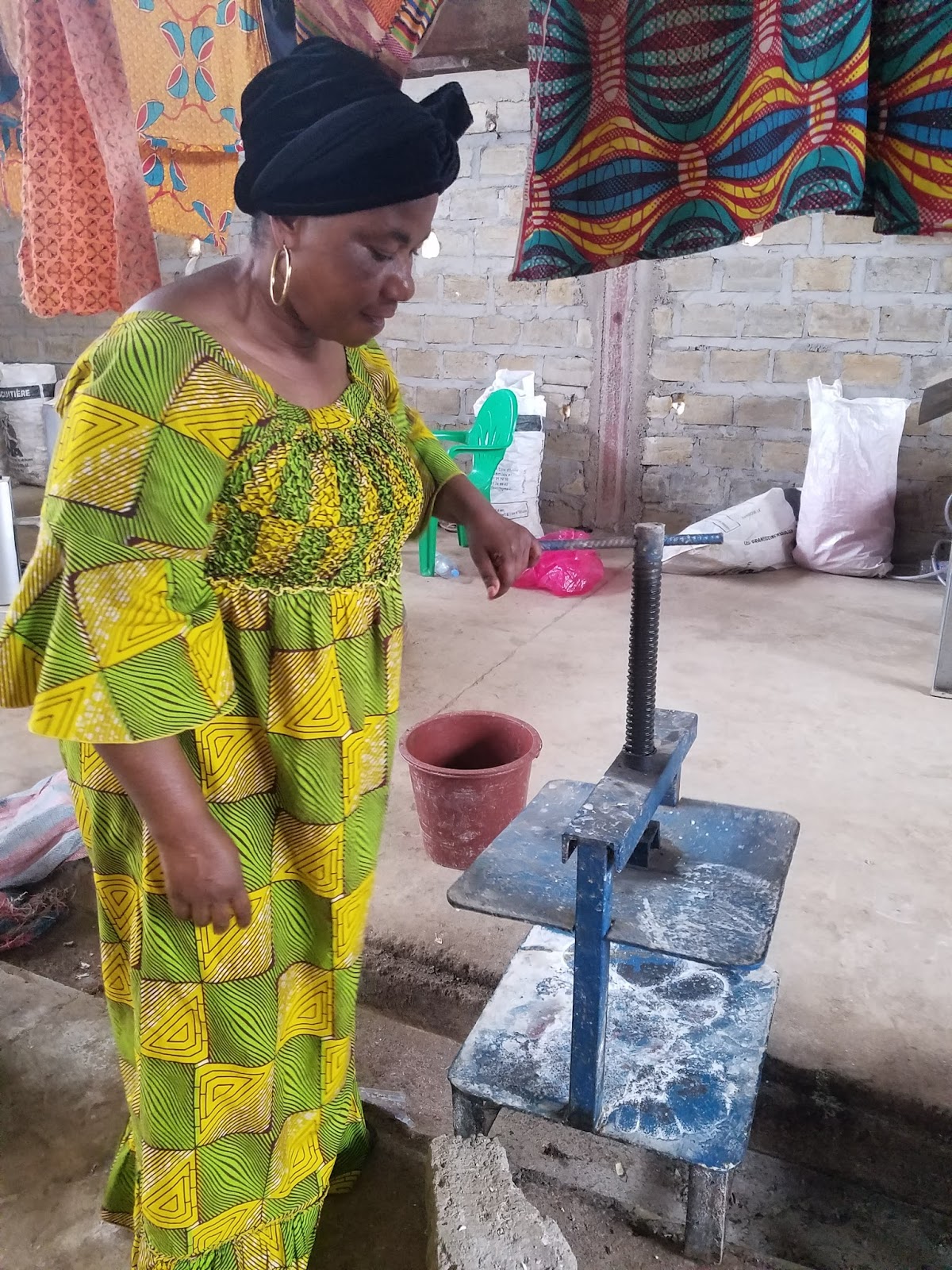
11/8/2017: A women's co-op leader shows me the traditional press for removing liquid from cassava (they just recently purchased a more mechanized processing system)


11/8/2017: Attending an open air session hosted by magistrates and a local NGO on how to access the justice system.
In addition to conducting interviews, I still was able to play tourist: visiting a sacred forest full of tiny monkeys, hiking to the beautiful waterfalls, watching the Elephants lose their World Cup qualifying match, partaking in local alcohol products.

Clockwise: Palm wine in a Wobé village east of Man; feeding the monkeys in the Gbêpleu sacred forest; the famous cascades of Man; rooting on the Elephants in a local bar with NGO folks
I also attended the 7th annual Mask Festival. Traditional masks from across the region and elsewhere made their way to the three-day festival: there were some masks who were aggressive and frightened onlookers, there were humorous masks that encouraged (for a fee) photo-taking, there were masks on stilts, and there was plenty of dancing and mask races. Attendance was high, with young people and old alike laughing and pointing, screaming and running (and then laughing), all trying to get a glimpse of the mystical beings. It was a compelling and intriguing cultural experience.

11/11/2017: Some of the masks we saw at the festival

Sunday, March 17, 2013

Adventures from the North

I referenced here the inequalities that existed between the North and South in relation to education, so I was excited to spend five days in this region of Côte d'Ivoire.

The cities

Boundiali
 Our first stop was 731 km from Abidjan. A quiet, not very crowded city er, more like a village, Boundiali was welcoming. There were very few cars in the city; everyone rode motorcycles or bicycles. The roads weren’t paved, just dusty, red passageways. We stayed at a hotel called le Dala, which was inaugurated by Houphouet-Boigny in the 1970s. It seemed like the hotel hadn’t been repaired or upgraded since then either… upon arrival, the porter told me there was TV in my room, but neglected to mention that there was no running water (in all of Boundiali, apparently!).

 Gbon
At first, I wasn’t certain why we were visiting this town, 30 some km from Boundiali. But I later found out that it is the Minister of Education’s native village and they wanted us to see it. We only spent the morning and part of the afternoon here, but like Boundiali, nobody drove cars and everything was coated in a red dust.
Korhogo
Two hours from Boundiali, we found ourselves in Korhogo. Like the other two cities, no taxis, so we had to take moto-taxis to get around. The President has a residence here, because his home village, Kong isn’t so far away. We didn’t have much time to explore Korhogo, but it seemed like an interesting city, if one could get over the outrageous temperature of 47 degrees Celsius.         


 The schools
I visited the north with two colleagues: the National Coordinator for EDHC (CND) and the CND for primary schools/CAFOP. It was pleasant to travel with both of these gentlemen, as they were equally enthusiastic about EDHC and went over and beyond the expected workload by holding open sessions for teachers with complaints and questions in addition to the class visits.

In total, we visited six schools: Two elementary schools, three high schools, and one CAFOP (teacher training college). Each visited (with one exception, see below) consisted of us attending an EDHC lesson with other EDHC teachers from the school present, followed by a session of feedback and capacity building for the teachers.  

We quickly noticed a trend: most, if not all, of the teachers had yet to receive the new curriculum, available since September. However, we did have one principal admit that he had received the programs on a USB key, but hadn’t distributed them to the teachers. Or administrators said they had the program, but didn’t want to waste precious resources printing it for the others. This complaint, that the DPFC/MEN are not directly providing materials to teachers, was probably the most frequent. Even though they had the resource at their fingertips, many complained that they should have been given their own hard copy, instead of having to print it or copy it. When asked, well if you aren’t teaching from the curriculum, what are you teaching from? Teachers responded that they used the old ECM textbook, which doesn’t present a huge problem, per se, because the content is similar, but it frustrated my colleagues who have been pushing for the APC teaching methodology.

As mentioned in my post about Yamoussoukro and Bouaké, the biggest teaching strategy problems we saw were at the middle school level. Once again, dictation prevailed as a teaching method, despite the importance of participation in human rights and citizenship learning. In a lesson on entrepreneurship for 9th graders (many of whom are old enough to start their own business!), the teacher dictated the steps necessary to starting a business, including (but not defining) conducting a market study and a feasibility study. Students copied down what the professor said, but when I asked them pointedly how they thought this particular lesson would apply to their daily lives, many said it wouldn’t/didn’t concern them. Without directly engaging the students, they treat EDHC just as another boring lesson, which of course won’t facilitate behavior change, the main goal of EDHC teaching.

My colleagues were frustrated, and reiterated the importance of using interactive teaching methods, such as group work, brainstorming, field trips, class projects, etc. Some of the teachers reacted positively, while others crossed their arms and rolled their eyes. I told them that I understood that they were sometimes obligated against their desires to teach EDHC and perhaps weren’t motivated to come up with interesting teaching methods. I suggested that they work with the other EDHC teachers to come up with lesson plans, thus alleviating the burden of planning for EDHC on top of their other work. I hope they will take this to heart…

There were two events that surprised me during this trip.

First, we had a bit of a conflict with one of the EDHC teachers in Gbon. As we were visiting two schools in the city, we arrived a bit late for the open class in the Gbon middle school. Instead of waiting for us, which the principal told the teacher to do, the EDHC teacher released his students AND told all of the other EDHC teachers they could go home because “we were not coming.” Thus, when we came, there was literally no-one there. We were shocked. We hadn’t made the trip from Abidjan for our good health; we came to provide support to these teachers, who were constantly complaining that the MEN was neglecting them, and instead of waiting 10 minutes, they chose to leave. When the teacher in question was called upon, he shrugged his shoulders. The principal called all the teachers back, many of whom sat with their arms crossed during our session, complaining that the DPFC didn’t provide them with the proper materials to teach the lessons. We pointed out that as teachers, it’s part of their job to seek out interesting materials to be used creatively, and that we provided everything they needed as far as methodology and curriculum are concerned… what more did they need?  

The second event was a positive one. At the Houphouet-Boigny high school in Korhogo, I gave my surveys to a class of 9th graders, but for the first time since I have been conducting it, the teacher was not present. I think this allowed the students to feel more comfortable. When I told them they could ask me five questions after they finished, I expected mundane, teenage questions, such as “Where in the US are you from? Are you married? Have you met Beyoncé?” Instead, the students floored me with their extremely thought provoking questions directly related to EDHC: Do people who conduct awareness raising campaigns actually practice what they preach? We talk a lot about reconciliation, but then why is there still war in the world? How do I convince my neighbors that respecting vulnerable persons (handicapped people was the example) is the right thing to do? Why do we talk so much about human rights, but when the genocide in Rwanda went down, why did no one intervene? And finally, why do western countries talk about legalizing gay marriage?
I can’t say whether it was the doing of their EDHC professor or just their own interests, but these kids were obviously really reflecting on these issues. I tried to respond as best I could, but I found the whole situation refreshing… maybe, despite our worries for the teaching methods employed, EDHC was taking root in the students’ minds?


 The adventure

To arrive up north, we took “cars” or large 60+ person buses. I had a window seat, which wasn’t so bad as a cool breeze kept me somewhat comfortable. Considering that the drive from Abidjan to Boundiali took 12 hours, meant that my bum was a little sore from the metal/barely-covered seats. Under my feet were several guinea fowl in a box and they were more than loud and obnoxious. Not to mention they kept touching me, and I found myself wondering, when was the last case of bird flu again? On the way to Boundiali, we were “protected” by a Dozo (traditional hunter) who was sitting just behind the driver. Every time we drove through a checkpoint, he slowly lifted his hand, and we were allowed to pass. Dozos are believed to have magical powers because of their secret rituals in the sacred forests, and they played a pivotal role in the conflict. I am thankful he kept us safe on that ride though, especially when we would hit nasty bumps.

The road between Katiola and Korhogo was horrible. Huge pot holes made it so that we had to literally drive on the side of the road, often times tilted at seemingly unsafe angles. We saw some trucks that had flipped and I was appreciative when our driver took the bumps slowly.

On both the buses there were individuals who got on at a certain stop to sell us their cure-all medicines.
They would ask the passengers if someone amongst them had malaria, and would give one “volunteer” a little of the medicine. They would, of course, immediately feel better. My colleague seated next to me grumbled about how we wanted peace and quiet on our ride home, so I figured many of the others on the bus wouldn’t buy this stunt either. Surprisingly, though, many people listened intently to his diatribe about how the medicine could, if you took three bottles, cure you of paralysis, unblock fallopian tubes and facilitate pregnancy, and cure you of fatigue. Several bottles were purchased at a “special” low-rate just for us on this particular bus. Right.

Saturday, February 02, 2013

Escaping Abidjan

 
With some students in Yamoussoukro
Sometimes you don’t realize that you tired of a place until you leave it. I was able to get away from the pollution, traffic, and overcrowded Abidjan for a few days to go to Yamoussoukro and Bouaké for school visits and inspections from 20– 23 January. We did not get to go all the way to the North (as described in the previous post) because Thursday was a national holiday, Mawlid (Mohammad’s birthday), and we needed to be back in Abidjan.

The cities

Yamoussoukro
Technically the political capital of the country, the landscape of the city brings to mind some dusty highway in Arizona. Large, expansive boulevards cross the city, but there is very minimal traffic compared to the economic capital Abidjan. The founding father of the country, Houphouet-Boigny had big aspirations for his home village: he built a giant presidential estate complete with lakes filled with Caymans (who eat people!) and the most impressive feat, a basilica that is larger than Saint Peter’s in Rome (In fact, it is the largest Christian building in the world!) But, unfortunately for him, the city hasn’t taken on its role as the political capital and remains sparsely populated.

Bouaké
The second largest city in Côte d’Ivoire, Bouaké gets its claim to fame by being the former capital of the rebel held north from 2002-2009. This becomes very evident as one arrives from Yamoussoukro, as you pass a giant UN base just before arriving in the city (“little Pakistan” greets you just off to your left before the city). Bouaké suffered substantially during the conflict, with little to no infrastructural assistance from the capital, rebel lootings occurring frequently, and access to food being difficult for the population. From what I could see, however, Bouaké seemed to be making a comeback. Motorcycle taxis zoomed around town and there have been substantial government efforts to re-open the university.

The schools
I traveled with the General Inspector for the EDHC (human rights education) curriculum. Our intention was to do some organized school visits as well as some surprise inspections, and participate in question and answers sessions with professors on the new curriculum and new teaching methods.
In Ya’kro, we visited three establishments: a primary school/preschool, a middle school, and the teacher training college (CAFOP). In Bouaké, we visited several classes at a middle school.

The most refreshing and promising was the primary school levels. The teachers used creative teaching methods to introduce the EDHC topics (preschool – the colors of the Ivoirian flag; primary school – the importance of keeping your social space clean), such as group work, interaction between students and teachers, several different types of props, etc. In my experience thus far, this tends to be the case: since the primary level teachers are all trained to teach several different subjects, incorporating EDHC (previously ECM) into their curriculum is a piece of cake. Furthermore, it would appear that considering the age levels they work with, these teachers also have no restraints in using creative techniques to teach the content.

At the middle school level, however, things are not the same. As mentioned in a previous post, the teachers at this level are normally trained in a specific discipline and teach EDHC because they are asked to fill their extra hours (though there are teachers who volunteer to teach the curriculum, we have met very few). That means that these teachers, who have a upper level degree to teach their discipline (the elementary school teachers only do the equivalent of technical training+ internship to teach, a few years less than the middle/high school teachers), have to not only plan the courses for their discipline but also for EDHC, of which many have not received proper training, and let’s be honest, may or may not care one lick about. So as can be imagined, the classes lack creative teaching techniques, tend to be dictated to the students, and the content is often treated as theoretical concepts and not applicable to the students’ lives. When approached, the teachers themselves claim that they haven’t received training, which the response from the DPFC is, we’ll work on that, but we have provided you with the materials. To which the teachers respond, we don’t know how to use these materials/you don’t provide enough for us to work with. It’s as if, sometimes, they want the whole lesson to be laid out directly for them, instead of coming up with their own ideas. For me, coming from the US system, but being familiar with the French system, it is rather disappointing. EDHC has so much potential to be a “fun” class, and the teachers can use a variety of interesting techniques to get the students excited and to recognize the importance of it as a subject, and they are not doing this, unfortunately.

In Bouaké, we surprised the school for an inspection. And man, were they surprised. We asked to see the teacher schedule for EDHC so that we could pick a class to visit. We were told there were several classes being taught at the same hour, so we picked one and proceeded to go to it. What we instead found was that not only was the schedule the school had seriously out of date/plain wrong, but we discovered that several classes had never even had EDHC since the beginning of the year. Even more interestingly, the member of the administration that toured us around the school told me that “European children don’t need discipline. Our students here have had a lot of problems since the crisis, and they need a smack in the head every now and then. So it’s not fair that your [Western, presumably] organizations tell us not to hit students, because that’s what they need.” (he of course said this to me after he went into a classroom to discipline a student, a class that didn’t have a teacher in it, which was often the case at this particular school. With 4,800 students, I noticed that a lot of the classrooms were without a teacher/adult and the students were just in there, doing who knows what.)

The teachers we finally did see still called EDHC, ECM despite the change since 2009. The walls of the classrooms were covered in graffiti. In the class where I administered some surveys (9th graders), there were 19 year old students. Since middle school is not free, there is no age limit for students; instead, all students are obligated to complete the 9th grade, at any age. It was definitely a change from the schools in Ya’kro and those in Abidjan as well.

In short, I think it is really important to for me, and moreover for the DPFC, to get outside of the main cities to see about the other schools. The Inspector was very upset with the fact that there were students at the school who had never received EDHC classes and had a good talking to to the principal of the school. Hopefully, things will get changed, but who really knows.

The adventure

On the way to Yamoussoukro, we rode in a nice truck with A/C that belonged to the primary school inspector of Yamoussoukro (his family lives in Abidjan, so he often is there for the weekends). But as we were driving, the car started overheating and then just all together stopped working. We were out in the middle of nowhere on the side of the road, nothing but silence and stars and tall grasses around us. Luckily, a car passing by stopped and offered to pull us, yes with a rope, to the next village where there was another inspector that could help us out. Welcome to Africa :-)

For sleeping, in Ya’kro we stayed at the CAFOP in rooms that weren’t super fancy but were super free. Then in Bouaké we stayed in these rooms that were run by some Catholic priests who also had lots of animals running the yard and beautiful gardens.


For food, we were often treated (since I was, after all, with the general inspector) by the local delegation, so we ate very well. Since we crammed so much into each day, we were literally running around from 7am until 11pm, which was both exhilarating (things had been rather slow previously) and exhausting (considering everything was also conducted in French). Probably one of the highlights was when we arrived in Bouaké and the city was empty because everyone was watching the CAN (Africa cup) game against Togo.
 
I really had a nice time and look forward to other trips further north and to the east bientôt!

Monday, January 14, 2013

Coming soon: Adventures from the North


Soon I will be traveling to the North of the country to visit schools and evaluate teachers on the Human Rights curriculum. I will hopefully be attending some trainings, talking with students, and seeing how things are done up North. As you may know, the North was cut off from the rest of the country during the civil conflict, with many fleeing south or being displaced. In 2004, as many as 700,000 children were estimated to not be attending school. The number of teachers decreased substantially in the region, so non-governmental organizations often had to step-in to take over. 

The
Education for All initiative of the Global Monitoring Report demonstrates that there are serious inequalities between Northern students and their Southern counterparts: Students from the North are more likely to only have completed less than two years of schooling or to never have even gone to school. Between the ages of 15 and 19, the report estimates that those dwelling in the North are the most deprived groups, and more likely to be out of school compared to the South or those living in Abidjan.
In a report on Conflict and Education for the U.S. Peace Institute from 2010, the author asserts “The longer the government waits to rebuild the northern education system, the more the civilians and communities suffer. This in effect denies them their rights, limits their livelihood options, and frustrates entire generations of learners, further complicating reconciliation efforts.”
Therefore, my trip to the North has a few objectives: check out the EDHC teaching efforts for those farthest away from the capital, but also strengthen the relationship between the Ministry of Education and those who may have felt neglected by the government previously, while providing the Ministry itself with vital information about the performances of these schools.

Wednesday, September 19, 2012

I gave a guy a car and got a box of quail eggs! And other stories of first few days in Abidjan


I can already see that this West African experience will be quite different from my other adventures. Here’s why:

1.       Accommodation: I and two other Fulbrighters are staying in a very secure, nice, new building in the Riviera III neighborhood (not far from the U.S. Embassy). My apartment is air conditioned, with hot water and NOT cheap (my rent here will greatly exceed what I paid in Paris!), but it’s not easy finding secure, cheap, furnished housing in Abidjan, so I will take what I can get.


2.       Work: on Tuesday, 18 Sept. I went for the first time to the Ministry of Education, Pedagogy and Continuing Education Department, where I will be spending the next 10 months. It is located in one of the many sky scrapers of Abidjan. The building itself is a bit dilapidated, as it and its neighbors were attacked during the election violence in 2010-2011 (i.e. windows are shot out, some offices were clearly burned and never repaired, water is dripping from somewhere into the lobby, etc). The elevators are so slow and come so intermittently that there are chairs on each floor for you to wait. But, I’ll have a nice office (not finished yet) fully equipped and ready to go (I’ll even have my own toilet!).

This department (henceforth referred to as DPFC) just launched a new national curriculum, so they are now in the process of training teachers (already 3 000+ have been trained) and communicating the new strategy across the country. One new element is the EDHC (Human rights and citizenship education), which is exactly the type of curriculum I would like to work with. We’ll see.

Another interesting project is the teaching of local languages at the elementary school level. The idea is that students will be better integrated into the system if they start off by learning how to read/write in their mother tongue, and then slowly progress to French education. They have already had success in an initial pilot program (in classic schools, 73% of students advance, whereas in the pilot program 83% continued onto middle school).  The director of this program was really nice and already invited me to her home for Tabaski (Muslim celebration)!

On the first day, I met with my director and we discussed possible avenues for me. This followed a lunch with the deputy director, who then told me we were going to visit the lycée Classique (high school). I thought we were going to check out the training program for new teachers. When we arrived, there were hundreds of people lined up on the street clapping. Come to find out, it was actually a ceremony involving the Minister of Education, Madame Kandia Camara and World Bank officials, who had provided materials and several vehicles for the various school districts (many cars were stolen during the conflict, so administrators were unable to get around to visit/inspect the schools). It was a big affair with music and I even participated by symbolically handing the papers for one car to one of the district directors (Minister Camara thought it was a good idea to include l’américaine!) We then had a reception with the principal of the high school who explained that a student association had been raising quails all summer in order to sell the eggs as a business venture. He gave three boxes of quail eggs to Minister Camara, who then gave me a box! Apparently they are really good for you, if you drink them raw in the morning, several a day (haven’t tried that yet!).

In short, the first day was an exciting whirlwind of meet/greet (I met all the different curriculum heads and other important people) and official stuff. I learned my lesson, always bring my camera to work, you never know when I might do something cool like give someone a car! (I might even be on tv or in the newspaper!)

The second day was just as interesting, yet less official. I attended a seminar on using cell phone technology for statistics gathering in education. It is a new program, to be tried on schools here in Abidjan with the support of Orange (cell phone company) and Microsoft (who is making the application to be used on Windows phone, presumably) and UNESCO. It was really interesting to see how technology can be used in this capacity, and especially since Orange had successfully run a similar program in Senegal involving birth registration by cell phone. Since so many people have cell phones (and there may not even be roads in the villages!) it is an efficient way to transmit information over distances quickly. Getting the stats to the Ministry of Education will help them develop programs, find out what the schools need, etc. This idea, of integrating technology into education, seems to be really important to my boss, so maybe I will be working on these types of projects too?

3.       Daily routine: Riviera III is pretty far from Plateau, where I work, but the traffic is ridiculous and makes it even worse. Therefore, the people in the DPFC start at 7:30 to avoid the traffic and leave at 16:30. It’s going to be a very early start for me! This is a change from classes in Senegal or Ghana, which weren’t so early or every day.

So that’s that. Things have started off really well: I am making quick friends with the other Fulbrighters and have met a ton of cool people through work, especially the seminar on technology. So far everyday is a surprise, and I like it that way!