Wednesday, December 13, 2017

Data collection woes

Man Prefecture
I wanted to know if there was a comprehensive list of organizations that had been registered in Man. Organizations must first register their existence with the Prefecture, and when I went to ask about said list, the administrator said oh yes, thousands of organizations are registered here. Great, any way I can see a list? Oh no, there's no list, we just have all of the files (shows me to the above cabinet).

Prefecture de Bouak茅: Known locally as the "White House" this was the seat of the rebellion during the civil war. The post-2011 government did not want to set-up shop here, so established the Prefecture in a different location. In 2016, this new building was ransacked and destroyed by "young protesters". The prefecture re-established itself in the White House at the end of last year. 

In Bouak茅, we visited the Prefecture: "We used to have a full list. But when the Prefecture was ransacked last year, we lost everything. Hard copies of registration forms, our computers…everything."
Compiling the data I need for my dissertation, thus, will require a little creativity since these two anecdotes are more or less representative of other situations I found throughout the country: a lack of data in electronic format, destroyed documents during the crises, staff turnover resulting in lost or unfinished lists of organizations.

For Ivorian organizations, the loss of the lists is not the end of the world as they receive a receipt when they turn-in their paperwork at the Prefecture, and it is with this receipt that they are able to legally function - a lost file at the Prefecture does not mean they lose their right to work, thankfully. Nevertheless, a lack of a database with NGO registration information makes it difficult for a) the authorities to know who is working in the NGO sector in their department; b) the central state to know how many organizations work in a given sector; c) civil society organizations to know who else works in their domains; d) international donors and partners to know with whom to work; e) PhD researchers to collect comprehensive lists of organizations across the country 馃槙

Alas, this is fieldwork!


Tuesday, November 21, 2017

Man: 18 Mountains, resiliency, and mysticism

In early November 2017, I went the farthest west I have been in C么te d'Ivoire. Man, the capital of the Montagnes district (formerly 18 Montagnes) is nestled amidst the tallest peaks in the country and dense rainforest. Its most western regions border Guinea and Liberia.

Clockwise: The highest peak in C么te d'Ivoire, la dent de Man; the view from the cathedral of Man; sunset; view from Dioulabouga neighborhood, Man
But this region, despite its beauty, was also the site of some of the worst violence the country witnessed during its two crises; it is even known as the "Wild West" because of the lawlessness and proliferation of various armed groups from C么te d'Ivoire and Liberia. Still today it remains a volatile area as the location of current land disputes that resulted in seven deaths and displaced 5000 people in October 2017.

The organizations I spoke with here focused largely on health outcomes: the region has the highest HIV rate in the country, with C么te d'Ivoire having the highest HIV prevalence rate in West Africa and this has had a particular effect on orphaned and vulnerable children; gender-based violence was rampant during and after the conflict; female genital cutting is widely practiced and organizations work to help local leaders understand the negative health impacts of such practices (such as fistulas). After health, social cohesion and poverty reduction were the next most active sectors for NGOs: integrating former combatants proves difficult when victims do not understand why those who hurt them are receiving aid to integrate, while the victims receive nothing. Encouraging groups who fought each other to get along on public good projects proves futile when citizens do not trust their neighbors. Nevertheless, there is a commitment to overcoming the intercommunal violence and develop the region: folks recounted stories of their entrepreneurial endeavors: creating ecotourism sites and developing a rice farming consultancy firm and women banding together to form a co-op to increase local transformation of agricultural products. I admire the resiliency of a population who suffered so greatly in the past and hope that the positive growth seen in recent years will reach these groups.


11/7/2017: Interview with a local health organization

11/8/2017: Interview with an organization that does programming related to orphans and vulnerable children 
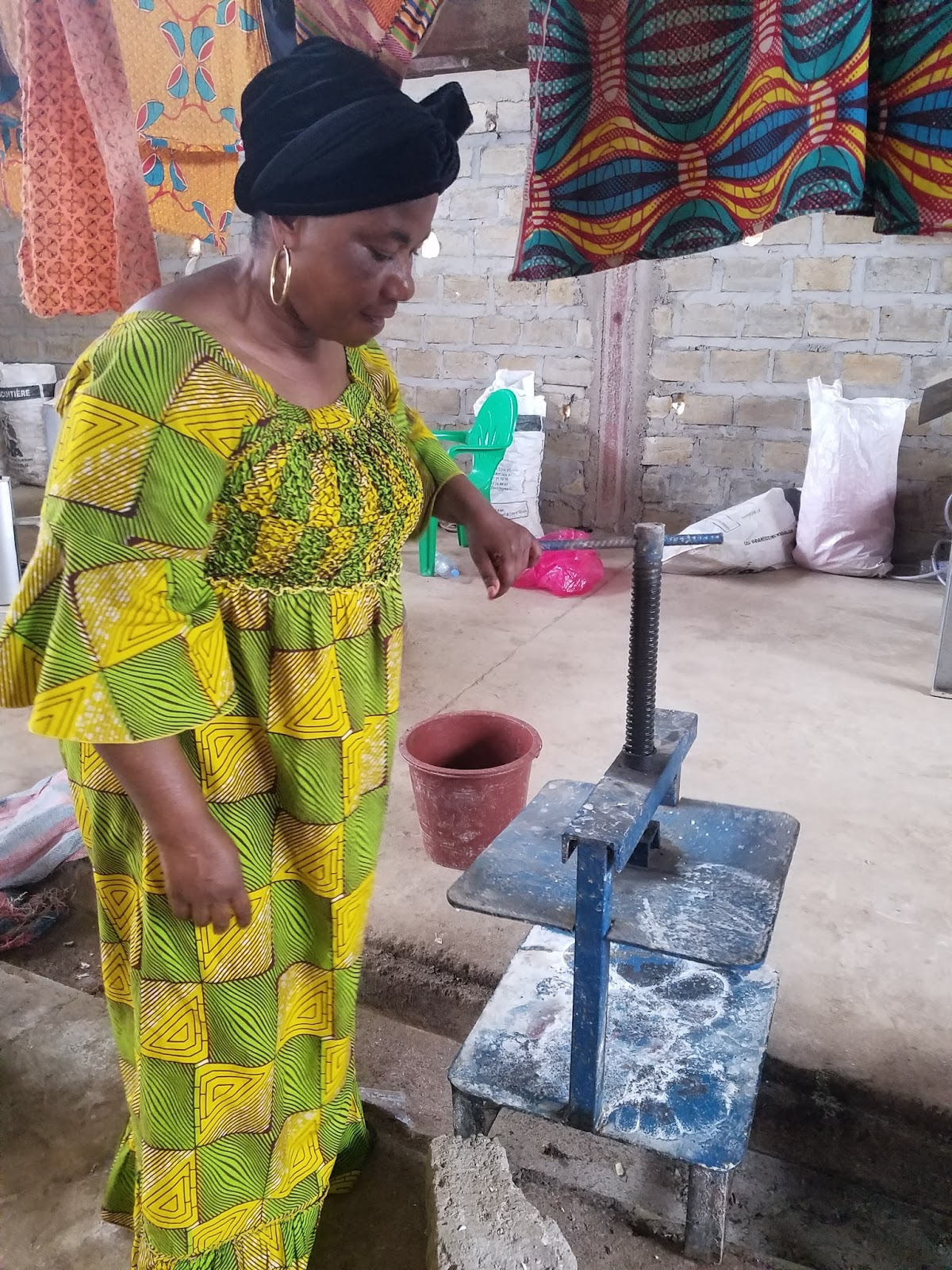
11/8/2017: A women's co-op leader shows me the traditional press for removing liquid from cassava (they just recently purchased a more mechanized processing system)


11/8/2017: Attending an open air session hosted by magistrates and a local NGO on how to access the justice system.
In addition to conducting interviews, I still was able to play tourist: visiting a sacred forest full of tiny monkeys, hiking to the beautiful waterfalls, watching the Elephants lose their World Cup qualifying match, partaking in local alcohol products.

Clockwise: Palm wine in a Wob茅 village east of Man; feeding the monkeys in the Gb锚pleu sacred forest; the famous cascades of Man; rooting on the Elephants in a local bar with NGO folks
I also attended the 7th annual Mask Festival. Traditional masks from across the region and elsewhere made their way to the three-day festival: there were some masks who were aggressive and frightened onlookers, there were humorous masks that encouraged (for a fee) photo-taking, there were masks on stilts, and there was plenty of dancing and mask races. Attendance was high, with young people and old alike laughing and pointing, screaming and running (and then laughing), all trying to get a glimpse of the mystical beings. It was a compelling and intriguing cultural experience.

11/11/2017: Some of the masks we saw at the festival

Wednesday, October 11, 2017

A lot has changed, much remains the same

I am back (again) in Abidjan, but this time for dissertation fieldwork! It has been five years since I first came to C么te d'Ivoire, and the country has seen many changes in the interim. Here are a few highlights.

Infrastructure and growth

New highways! Ground broken for a cross-Abidjan metro system! Burger King! I discussed new infrastructure projects when I was here in 2015, but even more have been completed since and more put on the docket. Between 2011-2015, C么te d'Ivoire has experienced an economic growth rate of 9%, a huge feat for a post-conflict country. However, there are doubts about how sustainable this rate can be: even this year, price drops on cocoa have affected the growth forecast (and has led to widespread protest by cocoa farmers in the southwest). Further, the everyday citizen does not seem to have felt the effects of this growth rate: Afrobarometer round 7 (2017) results indicate that the self-reported unemployment rate has increased from 73% to 76%. Ivorian friends say they have seen the roads being built, but for them this does not translate to jobs and relief of economic insecurity for their families.

Insecurity

In 2012, when I arrived for the Fulbright, every few weeks or so there were attacks on police stations and barracks, with unknown assailants taking weapons and sometimes resulting in causalities. Police and military barricades were the norm as one traversed the city. In 2013, things started to look better – the President got rid of all of the barricades and the attacks became fewer and farther between. Fast forward to today: after two 2017 mutinies by former rebels now integrated into the army, security forces are much more on alert. There were two prison breaks in the past month. A few days before my arrival, a police depot was attacked in Abobo, a commune of Abidjan. The government accuses pro-Gbagbo individuals of fostering this insecurity. The mutineers are still rattling their sabers (literally), attempting to take over the mayor's residence in Bouak茅 on October 2, demanding back payments to the tune of $33,000 each.

Further, on October 10th, an aide of Guillaume Soro, former rebel leader, current president of the National Assembly, was arrested and accused of hiding weapons in his home that helped the mutiny. Abidjan friends and colleagues expressed concern that this arrest would lead to violent confrontations between Soro supporters and the government, but so far things have been calm.

To top it off, security is also high due to recent terrorist attacks in neighboring Mali and Burkina Faso. In 2016, C么te d'Ivoire was the site of an AQIM attack, only months after similar attacks in Mali and Burkina. Metal detectors and bag checks are the norm at shopping centers and hotels, with particular attention paid to locations frequented by foreigners.

In short, despite the economic growth and the semblance of stability, there are still many issues preventing the restoration of rule of law in the country.

Justice

Former president Gbagbo is still at the ICC facing charges of crimes against humanity. His trial started on January 28, 2016, a little under five years after his arrest. In late September, General Mangou, who served under Gbagbo during the crisis, dealt a striking blow to the defense's case: indeed, Gbagbo had established a parallel command structure, based on personal ties and dependent on relationships with Bl茅 Goud茅 (also on trial at the ICC) and Gbagbo's wife, Simone (charged but acquitted of crimes against humanity), with the goal of "maintaining control of power at any cost."  Gbagbo supporters do not seem fazed by this revelation: calling Mangou a liar, a traitor, and a double agent because he swore his allegiance to the Ouattara camp the day after Gbagbo was captured in 2011.

Political competition

A once promising coalition, the RHDP (which joined together the PDCI and the RDR) is crumbling. The RHDP is effectively why Ouattara was elected in 2010; former president B茅di茅 of the PDCI threw in his hat for Ouattara in the second round of voting, pushing Ouattara's vote share over the needed 50%. And yet, the coalition was always on shaky ground: 2012 legislation to change the head of household laws in the country to be more inclusive was met with strong opposition from the PDCI camp, despite RDR's support – this led to a shake-up in the cabinet where Ouattara effectively ousted disloyal PDCI folks. In the 2016 legislative elections, former PDCI candidates who had run and even been elected under the RHDP banner were not renominated, choosing instead to run as independents (and sometimes winning) against hand-selected, loyal RHDP candidates. There is also discontent regarding the successor to Ouattara in the 2020 presidential elections: those RDR loyalists want an RDR face to represent the party, while PDCI folks feel that their commitment to the coalition should be rewarded with their own candidate, and it is now their time to shine.


The opposition remains fragmented, with the FPI (Gbagbo's party) only holding three seats in the national assembly. Time will tell whether this party will disappear as many former ruling parties so often do in Africa.

Tuesday, July 14, 2015

Survey: Perceptions of NGOs and the electoral process in C么te d’Ivoire

One of the major components of my research project is carrying out a public opinion survey about the electoral process, perceptions of NGOs and democracy in general. Due to budget restraints, I decided to limit the survey to Abidjan only, but with a representative sample coming from the 13 communes. The team has finished the interviews and are now working on data entry. Here’s how it went down:

First, I had to find a survey firm to carry-out this work. I selected the Afrobarometer implementing partner, the Centre for Research and Training on Integrated Development (CREFDI). I chose them because they came with high accolades from other researchers, but also because they are very familiar with Afrobarometer’s sampling and interviewing protocols as they have been working with Afrobarometer for two rounds (2013 and 2014, rounds 5 and 6).
CREFDI staff, 4 June 2015
Second, I developed the survey (well, over the course of the year during my classes, specifically a survey design course) and with input from COSOPCI. I then had six Ivorian university students pilot the survey online, to help with the response suggestions and survey flow (special shout out to my husband as well who corrected my French).
Piloting the survey, 27 June 2015
Then it was onto training the enumerators. I worked with a great team of eight enumerators, two supervisors, two data entry folks, and of course the director of CREFDI. On training day we went through the survey question by question, responding to any problems or comprehension issues, and distributing the 520 questionnaires to the teams. The questionnaires were printed, because, although ideal, tablets or phone surveys were outside of my budget.
Enumerator training 3 July 2015

Me and the team 3 July 2015
The questionnaire was administered between July 5 and July 12. Each team of four was overseen by a supervisor, and divided up the 65 enumeration area between the two teams (at random). An enumeration area, ZD here, are determined geographically by the Statistics Institute (INS) in charge of carrying out the census. The ZD are comprised of 1,000 to 1,200 individuals on average. Following Afrobarometer protocol, 8 respondents would be interviewed per ZD, thus, I needed 65 ZD for this study in order to reach a 520 respondent sample. The distribution of the ZD was determined after the 13 communes of Abidjan were stratified based on population; thus Yopougon, the largest commune, was allotted 15 ZD, while Treichville and Plateau, the two smallest, were allotted one ZD each. The ZD were then selected at random by CREFDI. Each team, then, would complete 40 respondent interviews per day, meaning five ZD per day, 10 interviews per enumerator per day. Because the ZD were chosen at random within each commune, sometimes the teams would start in the north part of the commune and then have to take a Gbaka or Woro-Woro to get to the other side of the commune, especially in the two largest communes of Yopougon and Abobo.
Abidjan, Communes not included on this map: Anyama, Bingerville, and Songon. http://data6.blog.de/media/070/5498070_544c450bb6_m.jpeg
I went out with each team for a day to see how things were going and to observe any difficulties they encountered. To determine which household to interview, the team followed the Afrobarometer sampling protocol: they would meet at a randomly selected intersection, one interviewer would walk East, another West, another North, and another South. They would select the fifth household that they encountered. If there was someone home (which was more often the case than not), they would give a brief recruitment speech explaining the purpose of their visit, show their CREFDI badge to demonstrate their credibility, and ask to make a list of the members of the household in order to randomly select the person to be interviewed. They alternated by household whether they would target a woman or a man for the interview (all respondents had to be over the age of 18). From the list they would have the member of the household draw a number, and that person was the person selected to be interviewed; if they were not home or if they refused, the enumerator was to leave the household and continue counting. If they agreed to participate, they had to give verbal consent, and the survey could commence.

Interview in Yopougon, 7 July 2015

Interview in Koumassi, 7 July 2015
From witnessing this process, I learned a few things:
  • A lot of people live in households in Abidjan; sometimes the people who lived there were uncertain about the number of people who were residing in a home. 
  • People do not particularly like divulging their age. It was the first question (because if they were not an adult, they could not complete the interview), and the enumerators were good at convincing people to give their age (“it’s so we can make sure you are of voting age”). People thought that asking age was not anonymous, which I still don’t completely understand. 
  • Most people like to talk, and one of the downsides of public opinion surveys with mostly closed questions is that their thoughts are not necessarily recorded. One respondent in Koumassi said he would not participate in the elections because he was afraid. The enumerator coded this response on the survey and continued onto the next question, but the man asked “wait, don’t you want to know why I am afraid?” and then told us stories of what had happened to him and his family in 2010-2011. 
  • On the other hand, there are some people who do not want to talk. Women in particular were reticent and often responded with I don’t know to many of the questions. 
At lunch with the first team, they asked me if in the U.S. there was a tradition about inviting someone into your home. I said no, not really, I mean I guess you could offer them something to drink? The enumerators were surprised: “if you don’t offer someone water and ask about the ‘nouvelles’ (news), it is clear to the visitor that they are not welcome.” They said that outside of Abidjan the welcoming experience varies, with some ethnic groups offering all you can drink liquor or Kola nut to guests in addition to water. At each interview, we were welcomed in, even before the household member agreed to participate, offered water and offered a seat. 
Discussing welcoming protocol over peanut sauce lunch, 3 July 2015
The data entry team is now busy at work inputting the responses from the 520 interviewees. I expect to be able to analyze the data, at least preliminary data, this weekend; I will hopefully give a dissemination presentation of the descriptive statistics to COSOPCI and CREFDI before my departure; two more weeks, so a lot of work to do!

Saturday, July 11, 2015

How does one educate potential voters to go register?


As mentioned in a previous post, the Electoral Commission (CEI) gave funding to 10 civil society coalitions to conduct sensitization campaigns on the voter registration process. But how was this carried out? I went out for two days with a team in Abidjan, in the commune of Adjam茅, and two days with two different teams in Divo (more specifics on this here). I have also interviewed 7 of the 10 of organizations working throughout the country to get a good grasp on the work they carried out as well as the obstacles they faced.

1. Wait for the money (…)
The CEI did not disburse the funds for the sensitization campaigns for two weeks; normally sensitization should happen before the registration process begins, but alas, this was not the case. In the second week of June, the CEI finally gave enough money to cover 10 sensitization agents, at 10,000 CFA (~$17) per day per person for a period of 10 days. However, COSOPCI (and other coalitions) found that 10 agents was not enough to cover the neighborhoods they had been assigned, so they increased the number of agents to 20 (or even 30!) and decreased the daily allotment. The Abidjan agents complained that for the Presidential elections of 2010 and the legislative elections 2011, they were paid much more: one agent told me they received 15,000 CFA (~$25), while another argued that the pay depended on which NGO coalition you worked for, as some gave more than others despite the fact that they were supposed to have the same budgets.

2. Training 
COSOPCI training, 11 June 2015
In Abidjan, COSOPCI sent out emails to all of its members to recruit sensitization agents; eight NGOs responded by sending candidates. A total of 19 individuals participated in the training and the subsequent sensitization process, eight of which were women. At this training session, questions were answered about the sensitization process (“what time do we start? Do we have to work on Sunday? How can we take pictures for the report if we don’t have cameras?”), while the director leading the training put emphasis on visibility (putting up as many posters as possible) and coordinating efforts with local leaders (religious, community, women’s associations, youth associations, etc.). 

COSOPCI agents, 11 June 2015
 COSOPCI was assigned to cover Adjam茅 (population: 372,978; 68% Ouattara in the 2010 elections) and Attecoub茅 (population: 260,911; 53% Gbagbo); only two of the 19 agents had actually lived in these communes, while most were vaguely familiar with the neighborhoods. Eleven agents volunteered for Adjam茅, while the remaining eight were assigned to Attecoub茅 (at the beginning, only four volunteered for Attecoub茅, but the director coaxed/forced the others onto the Attecoub茅 list; the reason being that Adjam茅 is closer to where most people live and people are more familiar with Adjam茅). One agent expressed her worry that they would show up in a neighborhood where they were not known, and did not know anyone there, and ask to be put in touch with local leaders. She said that people would find this bizarre, saying how can you come here where you are a stranger and sensitize us when you are not even prepared? The director responded that upon their arrival in a neighborhood, it was important to go first to the authorities where they would be welcomed and pointed in the right direction. Later the same woman, half joking, asked whether COSOPCI would be distributing boots for the folks working in Adjam茅 as the rainy season would make the routes quite muddy.

3. Visit the authorities
After receiving their t-shirts and poster kits, the Adjam茅 team met up on Monday morning at the Adjam茅 town hall. There we waited around for two hours to get a document signed which authorized the sensitizers to work in the area. Additionally, we requested a list of local associations with whom we could coordinate our activities; instead it was a list of individuals, most of whom were “party cadres,” but who in the end knew the neighborhoods well.
Town hall of Adjam茅 15 June 2015
We also went to the CEI offices, but they were closed on Mondays; over the course of the 10 day sensitization period, the team leader went three times to the CEI to get their approval, but two of the three times there was no-one in the offices (despite the fact that they were supposed to be open from early in the AM until at least 6pm) and the third time they did not have the stamp to approve the paperwork… so they were technically never accredited by the CEI to do the work.

The very closed CEI offices 15 June 2015
 4. Posters

First we divided up into teams of two, male-female when possible and two different organizations if possible as well. Adjam茅 was thus divided into five neighborhoods that the teams were to cover. Next, we started walking around and putting up posters throughout the neighborhood, starting on the main route and working our way north – our neighborhood was concentrated around the Marie Therese Houphouet-Boigny hospital. The agents complained that they had to spend 1,000 CFA (~$2) to buy poster glue out of their budgets and had to print sign-up sheets on their own dime as well. We asked before putting up the posters, and most people said yes because they figured it was the government carrying out the effort (more on this later); we put posters at popular spots, the bakery, pharmacies and private clinic, near bus stops, markets, grocery stores, public maternity wards. Of course, we risked having the posters torn down; one of our posters near the hospital was torn down, those working in Attecoub茅 bemoaned the fact that several of theirs were removed, while in Cocody, the National Agency for Urban Hygiene told agents that they were not allowed to put up the government issued posters. 
Putting up posters 15 June 2015
Working through the rain, the Red Cross was a voter registration center in Adjam茅 16 June 2015
 5. Canvassing – Who are you?

In Adjam茅, the teams focused, the first two days, on local businesses and markets. We spoke to salespeople in electronics and hardware shops, ladies working in the grocery store, women selling pineapples in the market. One of the agents introduced themselves as an agent of the CEI; this worked for getting poster approval, but with groups that were skeptical of the current government, they were not impressed to be talked to by this “politician”. To avoid problems, her partner stepped in and explained that they were not politicians but members of civil society; they were not “doing politics” but instead encouraging all sides to register to vote. Similarly, another team was refused entry to an Evangelical church for the same reason, but later allowed access when they explained they were not politicians either. One of the Attecoub茅 teams “barely got away” from a potentially problematic situation in the fish market, where they were thought to be representing a political candidate. In Divo, agents were chased away from certain villages. However, the Adjam茅 team concluded that things this year were much easier than in 2011, when the wounds of the 2010-2011 crisis were still fresh, and the opposition had already declared a boycott. Then, one agent told me, he was attacked with fish by ladies in the market for trying to talk to them about registering to vote; these were FPI partisans and wanted nothing to do with the process.

At a hardware shop, 15 June 2015
Ladies in the market, 16 June 2015
 In Divo, we concentrated on households. People welcomed us into their homes, even those who were uninterested or against the elections, offering us water and a seat and asking for the news of the day.

6. Avoid “Palabre” 
A shopkeeper saw us coming, read our shirts, and said “Voter list? We don’t want ‘palabre’ here!” Palabre in Ivorian French means “fight” or “trouble.” The agents told me, as members of civil society, it was their job to remain neutral in their proceedings. However, sometimes one had to commiserate with the population in order to get them to listen and understand; other times, it’s better to not engage in any sort of political conversation, to tell people how to register and to move on. An agent who did not hesitate to let me know he supported the opposition, said sometimes he had to level with folks, letting them know his affiliation, that he understood where they were coming from, but that it was his job to sensitize the population about the benefits of voting. Sometimes it backfired, as he was called a hypocrite, a sell-out or accused of only doing this work for the money, but sometimes it worked. A group of young men engaged us, asking ironically what is democracy when they send your candidate to jail, and I could see one of the agent was visibly uncomfortable. Afterwards, she chastised her partner for engaging with those guys, and told him next time to just give them the information and move on, because you never know where it might lead. An agent who worked in Yopougon, a known Gbagbo stronghold, recounted that they were told to not go to certain specific neighborhoods, because they would be “attacked and hit like they did to the census agents last year.” She told me they had no choice but to heed the warning, and avoided certain areas for fear of violence.

7. The information provided
I discussed here the issues of papers, arguing that the CEI did not do a wonderful job of conveying which papers were required to register, and there were generally problems for people who had been waiting months to receive their ID cards. Additionally, it was important to drive home the point that even if you did not feel ‘concern茅’/implicated by these presidential elections, it was still crucial to go register because it was the last chance for the next five years; meaning you would not be able to vote in the presidential, legislative, or municipal elections. The agents also encouraged the folks sensitized to spread the word in their families, particularly those who had recently moved or turned 18. Agents did not help people register directly, but were the only providers of information on where the local registration centers were, since the CEI was not conveying this information in a general manner. Finally, the agents tried to keep track, for their reports, of how many people they reached, by asking people to sign a register with their full name, occupation, and cell phone number as well as signature. When I first learned of this, I was certain people would not comply; that’s not very anonymous, I thought, and it is true that many refused to put their name down. Even one individual in Divo feared that we would send his friend’s name to the President who would do who knows what with the list and come find him. The agents tried to convey the purpose was just to have a record, but many shook their heads and refused. But most complied after being told the goal, while those who were illiterate signed their names with an X.

In short, every day the agents were out from 8 or 9am until well into the afternoon, on foot, conveying the information for less than $2 an hour. They did not deal with physical violence, but did have to deal with difficult areas. The two teams with which I worked were very committed to spreading the correct information to the populations, and bemoaned the fact that the CEI was not facilitating the process for them or for the population. 

The team in Divo, 20 June 2015
The Adjam茅 team, 16 June 2015


Tuesday, June 30, 2015

Impediments to voter registration in C么te d’Ivoire


Starting June 1, the Electoral Commission (CEI) has launched a major campaign to revise the 2010/2011 voter registration list. Basically the goals are threefold: to make sure that those who have moved or prefer to vote in a different locality (and voted previously) are in fact on the list at the right polling station; to remove those voters who have died from the lists or who have married and changed their names; and to enroll those who were previously not on the lists (those who are over the age of 18, those who failed to register previously, newly naturalized citizens, etc.)

A FAQ to be distributed during the sensitization campaigns
Papers
In order to register, one needs to bring one of two identification documents, either one’s certificate of nationality, or one’s national ID card. The catch is, the certificate of nationality issued before 2015 is no longer valid, as there were a lot of problems with fraud and so the new certificates are “s茅curis茅” and cost 3,300 FCFA (~$6) to obtain from the Ministry of Justice; many people do not have the newest certificate. What about national ID cards? Well, if you have it, you are set and can easily register to vote. If you never had one or you lost yours, you’ll have to request a new one from the Organization of National Identification for 5,000 FCFA (~$10); but to do this you need the NEW certificate of nationality, and you will have to leave the original with the ONI office, to obtain a receipt of payment until you receive your ID card. So, let’s say I lost my ID card last month, and I went to the ONI to get a new one. They take my original certificate of nationality, and hand me a receipt for the ID card, telling me I won’t have the ID card for another two months. Time to register to vote rolls around; I now no longer have the original certificate of nationality nor an ID card, and the CEI does not accept the receipt for the ID card as valid identification to register to vote. So I can’t vote, unless I spend the time and money to re-obtain a copy of the certificate of nationality, which probably takes just as long to obtain as an ID card.

This was the most common complaint about the process that I have encountered working with the sensitization agents; despite the fact that many people said they wouldn’t register or were uninterested in the process, many who were interested felt discouraged because their papers were not in order. And since the campaign was only for a period of one month, it severely limited who was able to register now. In particular, it disproportionately affects young people, as they are the least likely to have the papers needed.
photo: a young man who was able to register to vote with the old certificate of nationality; Divo June 2015
CEI itself

The CEI centers are understaffed and those who are there often left earlier, according to both of the teams I worked with. CEI agents defended themselves saying that oftentimes nobody showed up to register anyway, so why should they stay open? Additionally, the CEI has failed to let the population know where the centers are where they could register, so that was left to the sensitization agents; meaning if you were not reached by these agents in the neighborhood, you may not ever know where it is you were supposed to register.

There was also confusion as to who was supposed to go to the centers; on posters and even on my t-shirt it says “I will verify that my name is on the voter list.” However, many people went to the centers to do just that, only to be turned away and told that the centers were only for those who needed to newly register. About halfway through the month, the CEI changed their tune, but at that point many were already discouraged and did not desire to return. On top of that, we had one elderly woman approach us, saying she had tried to check her name on the list, but was told to go to a web site to see if her name was there; this supposed website of course does not exist, but also this woman had no idea how to use internet, and had purposely made the trip from afar to verify her name.

The CEI is underfunded, especially in comparison to 2010. International donors do not see much at stake in these elections, and those who have chosen to support it can only do so much. The population notices the difference, pointing out the fact that media campaigns on the process were much more widespread in the past, while this year it has been sparse at best.

Finally, the CEI has so far failed in its efforts – they were expecting 3 million new registrants, but have received around 400,000. Today was supposed to be the last day, officially, for registration, but they have extended the process by two weeks (until July 12). However, since the main obstacles seem to be about paperwork, extending by two weeks may not help the problem. The other question is whether they will extend the sensitization process as well.

Apathy and Acquiescence
Not really a direct impediment, per se, but people have lost faith in the democratic process associated with elections after the crisis in 2010. With an impressive 80% turnout rate (53% of the voting age population, which is the same as the US), people expected those elections to bring the violence and war to an end; unfortunately, the elections did just the opposite. People are therefore fearful and distrusting of the electoral process.

Furthermore, many people do not see the CEI as legitimate. The current CEI president, Bakayoko, was the CEI president in 2010 and it was he that declared Ouattara the winner; many believe that he should not be the current president because he has this partisan perception. The opposition has been calling for this to be changed since he was re-elected, by members of the [not perceived as neutral] commission.

Finally, there is the question as to whether Ouattara himself is legitimate, again bringing up the issue of nationality since both his parents are not believed to be Ivorian.

photo: a heated discussion with those who did not want to register because “their candidate” is not participating in the elections; Adjam茅, June 2015

Monday, June 22, 2015

Divo: A tale of two neighborhoods

In a family compound, a woman turns a large roasting kettle full of peanuts while another sits on a low bench tossing peanuts in a basket to remove the casings. Several children dart about, climbing on large plastic bags full to the brim with peanuts. Here, the women tell us that they have registered to vote, that they heard about it on the radio.
A Dioula family eager to have their photo taken (Divo, June 2015)
Young men in the street approached us to inquire about the meaning of our t-shirts and to get more information on how to vote; once they learned they nodded and said they would go right then to the CEI center to register. A few streets down, we are directed to the Imam’s house, who graciously welcomes us, takes all of the posters and documents and promises to include the information in his Friday sermon.
The Imam of Divo, third from the left (Divo, June 2015)
On the other side of town, we step under an overhang filled with young men. Flies lazily circle plastic cups of palm wine sitting on benches; the looks on the men’s faces are not particularly welcoming. “We voted in 2010, and they took up guns and put our president in jail. Why would we vote this year?” enquires a young man who was more willing to open up when he thought I was from Sierra Leone and not from the CEI. The men in the overhang listened, not very attentively, to the speech given by the electoral education agents, but refused to note their names on the list to demonstrate to the NGO that they had been spoken to by the agent. We continue to a group of women making and selling attieke. One laughs when the topic of elections eventually comes up: “Who do I vote for?” The agent responded, “for your candidate.” She snorted and said “and if my candidate is not here? If he is in jail?”
One of the few men drinking palm wine who allowed a photo to be taken (Divo, June 2015)
These are two neighborhoods in Divo, Western C么te d’Ivoire. The first is called Dioulabouga, includes the mosque, and is inhabited by mostly Dioula-speaking Muslims. Of the 74 individuals we spoke with, almost 20 were tailors/dressmakers, several were taxi or bus drivers while others worked with electronics. Of the 23 women, only two had stated employment outside of the home, though I imagine those women roasting peanuts and making attieke were not only making it for themselves. The second neighborhood, Libraville, is near the Catholic high school and has several churches nearby. This is the heart of the Dida group; concentrated around Divo, they share their dialect with the B茅t茅, the ethnic group which former president Gbagbo belongs to. Here, the occupation makeup was different as well: Of 41, 12 were planters or farmers, while there were more government workers and professors here than in Dioulabouga.*

The electoral education agents told me that with the Dioula or Baoul茅 populations, there is no problem; they listen, they accept the information with no protests. The Dida, they said, that’s where the problem lies. In particular, young men turn and walk briskly in the opposite direction when they see the agents, or if the agents do talk to them, they shake their heads, suck their teeth and protest that there’s no point in voting, there’s not going to be any real elections.
Retired government workers and current teachers, vocal about the political situation (Divo, June 2015)
This group of retired teachers and government workers implored me to write down everything they said and to convey this information and their photo to Obama; to ask him to change the president of the CEI and to stop supporting the President he (along with former French President Sarkozy) "imposed" on this country. Under Houphouet-Boigny, under B茅di茅, even under coup leader Gue茂, they ate well, they recounted, but now old, retired men are hungry and can’t afford to pay their rent. “We can’t find food to eat, and you’re talking to us about elections,” they lament.

One could chalk up this attitude to poor losers since their preferred candidate lost in the last elections, but that would be misguided; the feelings of being wronged are real. One electoral education agent told me that they were chased from a village on the way to Gagnoa (towards the heart of Gbagbo country) where people told them that their families were killed, or arrested in the aftermath of the last elections. A dry cleaning shop owner told me that he had left Bouak茅 on foot with only the clothes on his back at the start of the rebellion in 2002; these individuals feel that justice was not served against those who had perpetrated massacres, human rights abuses, looting or outright fear during the 10 year civil conflict or during the election crisis. Victor’s justice is a common phrase as people wonder why Gbagbo is in the ICC while those who carried out treasonous acts during the rebellion are not; in fact, leaders of the rebellion hold key government positions and former rebels patrol the streets as new soldiers.

The concern is how these feelings will manifest themselves in the months to come. Two men said that they were rebels or would become rebels. Others said they wanted to see Ouattara removed, forcefully, from power. On the other hand, not all of the vehement opposition supporters alluded to violence, but instead to using the ballot box as a weapon: one man, when we were speaking with some of his female family members making attieke, said that they would all register, sure, but they would not vote on Election Day, to show that there is no candidate or real competition.


* This was of course not a representative sample of the population, as I was only able to cover parts of the neighborhoods over the course of a day. However, it is still interesting to see the differences, even within this convenience sample. 

Tuesday, June 09, 2015

When it rains, it pours: Rainy Season 2015


Having grown up in the southeast United States, I am no stranger to summer flash thunderstorms. And in fact, moving to California, where 90s R&B told us it never rains in the southern regions, and the drought is a frightening reality, I honestly missed storms and rainfall. 

But I do not remember storms like this when I was here in 2012-2013. 
The view from my room during a storm
Thunder and lightning are not a requirement in these Abidjan storms; instead, the bloated dark grey clouds unleash gallons and gallons of rain all over the city, turning paths into rivers and clobbering makeshift homes. The resulting clatter is impressive and lasts for hours. Children still play in the rain, but adults seek shelter wherever they can, or women wear plastic bags to cover their hair. Abidjan has faced precarious rainy season problems in the past, with major flooding throughout the city. But our neighbor, Ghana, has seen much worse this year: An explosion at a gas station resulted in hundreds of deaths, partially because people were seeking shelter from the rains under the awnings of the station, and the rescue effort was impeded by flooding. 
A nearby shantytown in the rain
The upside is the lower temperatures post-storm and overcast skies preventing the sun from baking the earth. Soon the storms will dwindle and the warmth will return. But for now, I will try not to forget the “Hajj 2013” umbrella a colleague lent me and hope that things will calm down before I travel into the interior of the country where the likelihood of washed out roads is much higher. 


Thursday, June 04, 2015

Why I am in C么te d’Ivoire (encore)

As I mentioned in a previous post, I am in C么te d’Ivoire to examine perceptions and attitudes towards election preparation in the run-up to the 2015 presidential elections. In particular, I will be focusing on the process of registering voters and the accompanying electoral education campaigns, as well as participating in the monitoring of the process to make sure that there are no discrepancies or attempts to prevent individuals from exercising their right to vote.

The Electoral Commission (CEI) has accredited 10 NGO coalitions to accompany them in their efforts to register voters and revise the electoral list this month. Here’s a map of where the organizations will be working:
Additionally, National Democratic Institute (NDI) has funded a platform of NGOs to monitor the registration process, and the organization I am working with, COSOPCI, will be doing this as well.

The International Foundation for Electoral Systems (IFES) is working closely with the CEI to make sure that this whole process runs smoothly; I attended a three day seminar in Dabou on voter education that included the abovementioned organizations and a few others + the CEI and IFES, where they validated a voter education manual, in order to make sure that all of the organizations working with the CEI are on the same page as far as messaging and programming is concerned. For example, IFES encouraged the NGOs to use “traditional media” like theater, in order to effectively reach populations that are not literate and as a means to engage youth in the process.

Watching an example of theater for education, Dabou 27-29 May

Some of us concentrating on the session on using ICT for voter education, Dabou 27-29 May
COSOPCI will be working in former President Gbagbo strongholds (Gagnoa 74% and Divo 56% for Gbagbo in 2010 second round), and believe that their work will be particularly difficult in these zones because they will be dealing with populations who may not be supportive of the electoral process or desire to participate in the elections. In other words, they will have to be particularly convincing in order to encourage these folks to come out to the campaigns and register to vote; they may also face hostile populations who do not trust an organization that comes from Abidjan and who may assume that the NGO is representing the government. Finally, to be affiliated with the CEI may hurt COSOPCI’s prospects, as many do not see the CEI as legitimate.

My role in working with COSOPCI will be the following:
  • Provide feedback and insights on the voter education materials and strategies to be employed
  • Evaluate the effectiveness of the campaigns via an original survey developed in conjunction with COSOPCI
  • Interview local populations and gauge how they perceive the process and their general sentiments about the elections as well as their perceptions and attitudes towards NGOs and the CEI
  • Provide capacity support to COSOPCI (i.e. making maps and documents, etc.)
In addition to working on a day-to-day basis with COSOPCI, I have also been conducting interviews with other NGO coalitions and with the CEI. I managed to convince a gendarme protecting the CEI to take this photo of me:


Things are starting out slowly because the CEI today distributed the funds for the campaigns (and the posters and t-shirts), so I think things will pick up soon, as they hope to register/revise the voter rolls by the end of June 2015.


Wednesday, May 27, 2015

Plus 莽a change…

So what’s changed in Abidjan since I left in 2013?

Landscape

One of the first things I noticed upon my arrival in Abidjan was how much cleaner it was. Shortly after my departure in 2013, the government forbade the use of plastic bags. As I mentioned in this post on Ghana, similarly in Abidjan everything went into (sometimes two!) black plastic bags, whether you were buying bananas, fried chicken, or groceries. Though not all plastic bags were deemed unauthorized, and though not every city is in compliance with the law, the results in Abidjan seem to be pretty clear to me: the grass on the side of the road is less littered with garbage and the open sewers swell less with black plastic.

Last rainy season, several neighborhoods experienced severe flooding, but in particular shantytowns in Cocody were especially hit: 39 died in the shantytown known as “Gobelet.” Those who have been to Abidjan before 2014 have seen this shantytown if they have ever made the trip between Riviera and II plateau as you probably crossed through Gobelet on your way to rue des jardins. It certainly is a precarious zone to build a neighborhood as it is crisscrossed by a creek and the valley does not look stable enough to hold homes. So, in July 2014, these folks were evicted (offered around $300 to skedaddle) and the shantytown completely demolished. It now looks like this:

http://www.gettyimages.co.uk/detail/news-photo/view-of-the-goblet-district-of-the-cocody-area-in-abidjan-news-photo/464034912
 Infrastructure

3eme pont, 3eme pont ! Alright, I was super excited to see and drive across the third bridge, named affectionately for former President Henri Konan B茅di茅 (see photo below: perhaps to appease him so he would not run against current President Ouattara in October?), and whose construction made traffic a nightmare on both sides of the lagoon when I was here last. It lives up to expectation, I’d say: a futuristic traffic interchange precedes it in Marcory, then you have a long stretch of highway with signs that look as if they are lifted directly from the French autoroute. The bridge itself is long and straight, several lanes but rarely crowded because of the 500 FCFA ($1) toll one must pay when crossing both ways. The toll stations are the same as one would find in Europe, and they even have exact change! The bridge pops out on the other side near the infamous Golf Hotel (this is where Ouattara camped out during the election crisis; and where I saw Stromae last weekend in concert). It makes a more direct route between the airport and my neighborhood, as well as direct access to several embassies.

The other infrastructural feat to occur since my departure is the Riviera 2 rond-point. This is connected to the bridge, and during my stay in Abidjan, the traffic caused by the construction was particularly horrendous. Well, they have finished the work and made quite a nice traffic circle; the problem is that it did nothing to improve traffic conditions… it perhaps made it even worse as cars can no longer speed through this area now regulated by traffic lights (and the occasional police officer – yesterday I saw a lady cop giving a Gbaka driver a piece of her mind for running the light!)


These changes may be seen as positive for the president as he attempts to build up political support for the elections in October (well, maybe not evicting the shantytown dwellers). However, not everyone is impressed with Ouattara's "concrete" achievements: LIDER, an opposition political party, posted this on their facebook page (rough translation below):
"In saying that Ivorians want something "concrete," Ouattara must have been thinking about the English word, "concrete," which would explain why he has exclusively focused his presidency on constructing things out of concrete. What's concrete for Ivorians is the high price of electricity, power cuts, the state of disrepair in the hospitals and clinics, the piling up of heavy arms by the rebels, pharmacies lacking medicines, a bridge that charges too much and is not profitable, high taxes, partial justice, increases in the cost of living, corruption and a partisan electoral commission...We are Ivorian and the only thing we expect concretely from Mr. Ouattara is that he puts into place democratic conditions and transparent and credible elections."
These are just my initial thoughts as I close out the first week of my return to Abidjan. More insights to come!

Monday, May 18, 2015

Back to Abidjan!

Here we go again! I'll be in C么te d'Ivoire from May 20, 2015 until July 27, 2015. This time I'll be carrying out a research project on election preparation and voter education programs in the run-up to the October presidential elections. These elections will be the first since the 2011 post-election crisis, when the country fell into months of violent conflict after both incumbent and opposition candidates declared themselves winners, leaving over 3,000 dead.

I'll be based in Abidjan, but hoping to travel with the Civil Society Coalition for Peace and Democratic Development in C么te d’Ivoire (COSOPCI) as they put on voter education campaigns and register voters throughout the country.  We'll be developing and conducting a survey in Abidjan about the elections and on citizens' perceptions of democracy promotion. This research is supported by grants from the West Africa Research Association and the Human Rights Center at UC Berkeley.

I am excited to return in a different capacity (as a researcher and as a PhD student) and to see how much has changed (or not!) in Abidjan.